Buy high-quality medical wheelchairs for comfortable mobility at home or in healthcare facilities. Available in manual, foldable, commode, and electric models with 24/7 delivery across Bangladesh.
🛒
Full set with regulator
Showing all 5 products



📚 Buyer’s Guide
A wheelchair is also called a mobility aid, rolling chair, or wheeled mobility device, is a seated vehicle designed to provide independent or assisted movement for individuals who cannot walk or who have difficulty walking due to physical disability, injury, illness, or age-related mobility decline. Unlike walking aids such as crutches, walking frames, or walking sticks (which still require the user to bear some weight on their lower limbs), a wheelchair transfers the entire body weight to the seat, completely relieving the legs and feet of any load-bearing requirement.
Wheelchairs belong to the broader family of assistive mobility devices, which also includes mobility scooters, power-assisted walkers, and prosthetic limbs. Within this family, wheelchairs occupy two distinct subcategories: manual wheelchairs (human-powered rolling chairs propelled by the user’s own arm strength or pushed by a caregiver attendant) and electric wheelchairs (battery-powered motorised chairs driven by a joystick controller without requiring any physical propulsion effort from the user).
Wheelchairs are available across a gradable range of designs, from basic standard folding transport chairs for occasional short-term use, through mid-range commode wheelchairs (dual-function toileting and mobility chairs) and reclining sleeping wheelchairs (fully adjustable rest-position chairs), up to heavy-duty bariatric wheelchairs engineered for higher weight capacities and electric power chairs designed for full-time independent daily mobility.
A wheelchair is used to restore, support, or supplement the mobility of any person whose ability to walk is temporarily or permanently reduced, lost, or absent. This covers a wide clinical and personal spectrum ranging from short-term post-surgical recovery all the way to permanent lifelong daily mobility dependence.
At the temporary end of the scale, wheelchairs are commonly used during post-operative recovery (after orthopaedic surgery, joint replacement, or lower limb fracture repair), short-term illness-related weakness, and rehabilitation following stroke or serious injury when the patient cannot yet walk independently but is expected to regain function over time. At the permanent end, wheelchairs serve as the primary daily mobility device for individuals with spinal cord injury (paraplegia or quadriplegia), cerebral palsy, muscular dystrophy, multiple sclerosis, motor neurone disease, permanent lower limb amputation, and severe arthritis.
Beyond pure mobility, wheelchairs serve additional functions depending on their type. Commode wheelchairs (dual-function toileting and mobility aids) allow patients who cannot transfer independently to the bathroom to manage toileting without a separate commode chair. Reclining sleeping wheelchairs (rest-position adjustable chairs) allow bedridden patients to be repositioned for feeding, respiratory comfort, and pressure sore prevention without a full bed transfer. Electric wheelchairs (battery-powered motorised mobility devices) restore a level of independent navigation for users with limited or absent upper limb strength who cannot self-propel a manual chair.
| Product | Frame material | Weight Capacity | Price (৳) | Status |
|---|---|---|---|---|
| Manual Folding Wheelchair | Chromed steel | Up to 100 kg | ৳ 8,500 | ✅ In Stock |
| Fat Wheel Manual Folding Wheelchair | Heavy-duty thick-gauge steel | Up to 150 kg | ৳ 11,500 | ✅ In Stock |
| Kaiyang Commode Wheelchair | Chrome-plated steel | Up to 115 kg | ৳ 10,500 | ✅ In Stock |
| Kaiyang Sleeping Wheelchair | Chrome-plated steel | Up to 120 kg | ৳ 19,500 | ✅ In Stock |
| Foldable Electric Wheelchair | Powder-coated steel pipe | Up to 150 kg | ৳ 65,000 | ✅ Available |
A manual wheelchair (a human-powered rolling mobility aid) operates through a straightforward mechanical system of interconnected structural and functional components, each playing a specific role in the chair’s movement, stability, and comfort.
The frame (the structural chassis of the wheelchair, typically made from chromed steel, stainless steel, or lightweight aluminium) forms the load-bearing skeleton onto which all other components are mounted. The frame supports the user’s full body weight and determines the chair’s overall durability, weight, and folding capability.
The rear wheels (the large 24-inch diameter drive wheels positioned at the back of the chair) are the primary propulsion components. In a self-propelled manual wheelchair, the user grips the pushrims (the outer metal rings attached to the outside face of each rear wheel) and pushes forward or backward to move the chair. In a transport or attendant-propelled wheelchair, a caregiver pushes the chair using the push handles (the grip bars at the top of the backrest frame) without the user needing to exert any effort.
The front castor wheels (the small swivel wheels at the front of the frame, typically 8 inches in diameter) provide directional steering and front stability. Unlike the fixed-axle rear wheels, the front castors rotate 360 degrees to allow the chair to turn in tight spaces, navigate corners, and change direction smoothly.
The seat and backrest upholstery (the PVC or fabric sitting and back support surface) provides postural support and sitting comfort during extended use. Armrests (the lateral elbow and forearm support rails) stabilise the user’s upper body position, while footrests (the lower-limb support platforms, either fixed or adjustable) keep the feet elevated safely off the ground during movement. Handbrakes (the manual wheel-locking levers positioned at each rear wheel) lock the chair in place when stationary, preventing unintended rolling during patient transfers and on slopes.
The folding mechanism (the cross-brace collapsible frame system) allows the chair to fold flat for car boot storage, ambulance transport, and compact home storage when not in use.
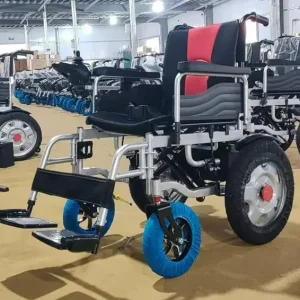
An electric wheelchair, also called a power chair or motorised mobility device, operates through a battery-powered drive system controlled by a joystick, eliminating the need for any manual propulsion effort from the user or caregiver.
The dual DC motors (two independent battery-powered drive units, typically 24V 250W each, mounted at the rear wheels) convert electrical energy from the battery into rotational movement at the rear wheels. Unlike a single-motor system, dual independent motors allow each rear wheel to rotate at different speeds, enabling precise in-place turning and smooth directional control in tight indoor spaces such as corridors, doorways, and bathrooms.
The battery (a rechargeable deep-cycle lithium or lead-acid power cell, typically 24V 20AH capacity) stores the electrical energy that powers both motors. A fully charged battery provides a drive range of approximately 20 to 25 kilometres on a single charge, sufficient for a full day of indoor and outdoor use without mid-day recharging. The battery is recharged using a standard AC mains charging adapter (a plug-in power supply unit) typically overnight.
The intelligent microcontroller (the 360-degree electronic joystick-operated steering and speed management system) receives directional commands from the user via the joystick, translates them into differential motor speed signals, and controls acceleration, deceleration, and turning in real time. Five adjustable gear settings (speed modes ranging from slow indoor crawl to full outdoor cruising speed) allow users to match their travel speed to their immediate environment and confidence level.
The powder-coated steel pipe frame (the corrosion-resistant heavy-duty structural chassis), breathable fabric seat (a ventilated upholstery surface reducing heat and pressure buildup during extended sitting), and front and rear wheel configuration (10-inch front castor wheels and 16-inch rear drive wheels) complete the physical structure of the electric wheelchair.
A wheelchair is needed by any person whose ability to walk independently is reduced to a degree that limits their daily activity, safety, or dignity, whether that limitation is temporary, progressive, or permanent.
The most common user groups span a wide clinical spectrum. At the temporary end, patients recovering from lower limb fractures, joint replacement surgery, or orthopaedic procedures may need a wheelchair for weeks to months while bone and tissue healing progresses. Post-stroke patients in the early rehabilitation phase, and post-surgical patients who are not yet cleared for weight-bearing, also fall within this short-term recovery group.
At the permanent end of the spectrum, wheelchair users include individuals with spinal cord injuries (paraplegic users with lower-limb paralysis and quadriplegic users with four-limb paralysis), patients with cerebral palsy (a neurological condition causing permanent movement and coordination impairment), individuals with progressive neurological conditions such as multiple sclerosis, Parkinson’s disease, and motor neurone disease, patients with advanced muscular dystrophy (progressive muscle wasting reducing mobility over time), and individuals with permanent lower limb amputation.
Elderly individuals form a large and growing user group who may not have a single diagnosable condition but whose cumulative age-related mobility decline (reduced muscle strength, balance impairment, joint degeneration, and increased fall risk) makes walking unsafe or exhausting. For these users, a wheelchair restores independence, prevents falls, and reduces caregiver strain significantly.
Choosing a wheelchair requires evaluating a set of core features against the specific physical needs, living environment, and daily activity patterns of the individual user.
Frame material and durability is the foundational consideration. Chromed steel frames (rust-resistant alloy chassis) offer the best combination of strength and affordability for most home and clinical users. Aluminium frames are lighter but less common in the Bangladesh market. Heavy-duty thick-gauge steel frames are the correct choice for bariatric users (heavier-framed individuals) or those requiring a higher structural load-bearing capacity.
Weight capacity (the maximum supported user body weight) must exceed the user’s actual weight with a safety margin. Standard wheelchairs support up to 100 kg, mid-range commode and reclining models up to 115 to 120 kg, and heavy-duty fat wheel models up to 150 kg.
Seat width and depth determines postural comfort during extended sitting. A seat that is too narrow causes pressure discomfort at the hips, while a seat that is too wide reduces lateral stability and armrest reach. Standard seat widths of 46 cm suit most adult users.
Folding capability matters for users who travel frequently, use vehicles, or have limited home storage space. A cross-brace folding frame collapses the chair in seconds without tools.
Footrest type (fixed, adjustable, or elevating) should match the user’s lower limb condition. Adjustable footrests accommodate varied leg lengths, while elevating footrests benefit users with lower limb oedema (leg swelling) or post-surgical leg elevation requirements.
Armrest type (fixed or detachable) affects transfer ease. Detachable armrests allow caregivers to perform lateral transfers from bed to chair or chair to toilet without lifting the user over a fixed side rail.
Additional functional features to consider include a built-in commode (under-seat sanitary bucket for users who cannot transfer to the toilet independently), a reclining backrest (for users who need to rest or lie flat in the chair), and a dual handbrake system (for heavier users where asymmetric single-brake stopping poses a tipping risk).
Choosing the right wheelchair is a matching exercise between the user’s clinical condition, their living environment, their level of independence, and their caregiver’s physical capability.
Start with the primary use case. If the user needs a wheelchair only for occasional transport and has some ambulatory ability, a standard lightweight folding transport wheelchair is sufficient and the most affordable option. If the user needs the wheelchair as their primary daily mobility device indoors and outdoors, a more robust self-propelled manual chair or electric power chair is appropriate. If the user cannot transfer independently to the bathroom, a commode wheelchair (dual-function toileting and mobility aid) eliminates the need for a separate commode chair. If the user needs to rest or lie flat in the chair due to bedridden status, stroke recovery, or post-surgical positioning requirements, a reclining sleeping wheelchair (a rest-position adjustable chair with 90 to 180 degree backrest recline) is the correct category.
Consider self-propulsion capability. Can the user operate a manual chair independently using their arms? If yes, a self-propelled manual wheelchair with pushrims gives the user maximum independence at the lowest running cost. If the user has limited or absent upper limb strength due to stroke, quadriplegia, or advanced neurological disease, an electric power chair (battery-powered joystick-controlled motorised chair) is the appropriate choice.
Consider weight capacity relative to the user’s body weight with a safety margin. Consider living environment: narrow doorways, bathroom access, stair presence, and floor surfaces all influence which frame size and wheel configuration will be practical.
If you are unsure which category suits your patient, call Care Plus at 01301 400 800. Their team will assess your patient’s condition, living setup, and budget and recommend the most appropriate model from their full range of manual, commode, reclining, heavy-duty, and electric wheelchairs.
The maximum weight a wheelchair can safely support is determined by its structural load-bearing capacity (the maximum user body weight the frame, seat, and wheel assembly are engineered and tested to carry without deformation, stress fracture, or mechanical failure).
Different wheelchair categories are rated at different load capacities. Standard manual folding wheelchairs (the most commonly used home and hospital transport chairs) are typically rated at up to 100 kg, suitable for the majority of average-weight adult users. Mid-range commode wheelchairs and reclining sleeping wheelchairs are typically rated at 115 to 120 kg, accommodating a broader range of user body types. Heavy-duty fat wheel manual wheelchairs (reinforced bariatric mobility aids with thick-gauge steel frames) are rated at up to 150 kg, designed specifically for larger-framed users for whom standard-duty chairs pose a structural risk.
Electric wheelchairs fall within the heavy-duty category, with most models rated at up to 150 kg, supported by dual motor drive systems and powder-coated steel pipe chassis engineered for sustained daily powered use under higher load conditions.
It is important to always select a wheelchair rated above the user’s actual body weight, not at exactly their weight. Using a chair at the absolute limit of its rated capacity accelerates frame fatigue, weld stress, and wheel bearing wear, reducing the chair’s safe operational lifespan. A safety margin of at least 10 to 15 kg above the user’s weight is the recommended practice.
The operational lifespan of a wheelchair depends on three interconnected factors: build quality (the materials and manufacturing standards of the frame and components), intensity of use (how many hours per day the chair is in active use), and maintenance regularity (how consistently the chair is cleaned, lubricated, and inspected).
A well-built chromed steel manual folding wheelchair used for moderate daily home and outdoor activity and maintained properly can be expected to provide reliable service for 5 to 8 years before significant structural fatigue, frame corrosion, or wheel bearing wear requires major repair or replacement. Basic standard-duty chairs used for occasional transport may last longer simply due to lower usage frequency, while heavy-duty bariatric chairs carrying loads near their maximum rated capacity may show accelerated wear on welds, axle bearings, and castor wheels within 3 to 5 years of intensive daily use.
Electric wheelchairs have a more complex lifespan profile due to their motorised components. The steel frame and seat upholstery may last 5 to 7 years under normal use, but the battery (the rechargeable power cell) typically requires replacement every 1.5 to 3 years depending on charge cycle frequency and storage conditions, and the DC motors may require servicing or replacement after 3 to 5 years of heavy daily use.
Wheelchair safety encompasses both the physical safety of the user during daily use and the mechanical safety of the chair itself as a load-bearing structural device.
For self-propelled manual wheelchair users, the most important safety practice is always engaging the handbrakes (the wheel-locking levers) before attempting to stand, transfer, or shift position in the chair. An unlocked chair on a smooth floor or sloped surface can roll unexpectedly during a transfer, causing a serious fall. On descending slopes or ramps, the user or caregiver should control speed carefully using the handbrakes rather than allowing free rolling.
For electric wheelchair users, staying safe means operating the joystick controller at an appropriately low speed setting in crowded, narrow, or unfamiliar environments. The slow indoor speed mode should always be used in corridors, doorways, and near other people. Outdoor use on wet or slippery surfaces requires extra caution, as the solid rubber tyres provide less grip on wet tiles and smooth pavements than on dry textured surfaces.
For all wheelchair users, doorway thresholds, uneven flooring, loose rugs, and bathroom wet floors represent the most common hazard zones in the home environment. These areas should be modified wherever possible, with threshold ramps, non-slip floor surfaces, and grab rails installed to reduce risk.
Caregiver safety is equally important. Pushing a wheelchair uphill should be done with proper body posture to avoid lower back strain. Descending slopes with a loaded wheelchair should always be done facing downhill with the caregiver in a controlled braking position, never allowing the chair to run freely ahead.
Always engage the handbrakes before any transfer. Every time a patient moves from the wheelchair to a bed, toilet, car seat, or standing position, both wheel-locking levers must be fully engaged before the movement begins. This is the single most frequently neglected safety step and the leading cause of wheelchair-related fall injuries at home.
Always check the footrests before standing. Footrests (the lower-limb support platforms) must be swung away or removed before the user attempts to stand or transfer, to prevent tripping, stumbling, or catching the feet during the movement.
Never tip the chair backward to climb a kerb or doorstep unless the caregiver is trained in wheelchair kerb-climbing technique and the tipping angle is controlled. Uncontrolled backward tipping of a loaded wheelchair can result in the user falling backward out of the chair.
Inspect the tyre and castor condition regularly. Worn or flat castor wheels (the front swivel wheels) reduce directional stability and increase the effort required to push the chair. Solid puncture-resistant tyres (the preferred type for home and clinical use) should be checked for cracking, splitting, or castor bearing loosening.
Do not hang heavy bags on the push handles at the back of the chair. This shifts the centre of gravity backward, making the chair unstable and prone to tipping when the user leans forward or the footrests are unloaded.
Ensure adequate seat support and posture during extended use. A user who slides forward or leans heavily to one side in the chair is at increased risk of pressure sore development (skin breakdown due to sustained localised pressure), postural spinal strain, and falls from the seat during movement.
Before committing to a wheelchair purchase, a structured evaluation of both the product and the supplier will protect against costly mistakes.
On the product side, verify the weight capacity against the user’s actual body weight with a safety margin. Confirm the seat width (46 cm is standard for most adults), seat depth, and seat height relative to the user’s body proportions, as a poor fit causes discomfort and postural problems during extended use. Check whether the frame is chromed steel, stainless steel, or powder-coated mild steel, as corrosion resistance and durability differ significantly between these materials. Confirm the wheel type: solid puncture-resistant tyres are far more practical for home use than pneumatic (air-filled) tyres that require pumping and are prone to punctures. Verify the brake type, footrest adjustability, and armrest configuration (fixed or detachable) against the user’s specific transfer and toileting needs.
On the supplier side, always purchase from a trusted, verified medical equipment supplier rather than an unverified online marketplace seller. Confirm that the product is brand-new (not reconditioned or previously used), that a warranty is provided, and that after-sales support is available for any mechanical issues that arise after delivery. Ask whether free installation and setup guidance is included at delivery. Confirm the delivery timeline, especially if the wheelchair is needed urgently for a patient being discharged from hospital.
You can buy an original, hospital-grade wheelchair from Care Plus, a trusted and verified medical mobility aid supplier in Bangladesh. Care Plus stocks the complete range of wheelchair types including standard manual folding wheelchairs, heavy-duty fat wheel bariatric wheelchairs, commode wheelchairs (dual-function toileting and mobility aids), reclining sleeping wheelchairs (rest-position adjustable chairs with full 90 to 180 degree backrest recline), and battery-powered electric power chairs (joystick-controlled motorised wheelchairs).
Everything you need to know about wheelchair in Bangladesh
24/7 delivery across Dhaka. Call us for wheelchair supply.