Buy high-quality pulse oximeters for accurate blood oxygen (SpO₂) and pulse rate monitoring at home. We offer trusted fingertip pulse oximeters with fast delivery across Dhaka and nationwide.
🛒
Full set with cover
Showing the single product
📚 Buyer’s Guide
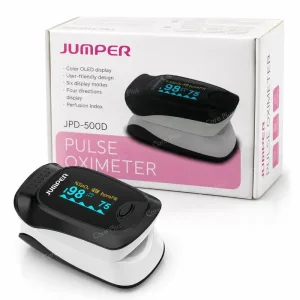
A pulse oximeter (SpO2 monitor or blood oxygen saturation meter) is a non-invasive fingertip medical device that measures the percentage of oxygenated haemoglobin in the bloodstream without drawing blood or requiring any painful clinical procedure.
It clips painlessly onto the fingertip, toe, or earlobe and uses infrared and red light wavelengths (photoplethysmography technology) to detect oxygen saturation in the blood, displaying the SpO2 reading on a digital LCD screen within seconds.
Pulse oximeters belong to the broader family of non-invasive monitoring devices, alongside blood pressure monitors and thermometers. They are available in fingertip clip models (the most common home-use type), handheld clinical models, and wrist-worn continuous monitoring models.
A pulse oximeter works by emitting two light wavelengths (red light at 660nm and infrared light at 940nm) through the fingertip tissue, measuring how much of each wavelength is absorbed by oxygenated versus deoxygenated haemoglobin in the blood.
Key working principles:
The pulse rate (heart rate or beats per minute) is simultaneously calculated from the pulsatile variations in light absorption caused by arterial blood flow, displaying both SpO2 and PR (pulse rate) readings on the digital screen together.
Anyone requiring regular blood oxygen saturation (SpO2) monitoring at home should use a pulse oximeter. This includes patients with chronic respiratory conditions, cardiac disease, and anyone recovering from respiratory illness or surgery.
Primary user groups include COPD (chronic obstructive pulmonary disease) patients, asthma sufferers, pulmonary fibrosis patients, COVID-19 recovery patients, post-surgical patients, sleep apnoea sufferers, and elderly individuals with age-related reduced lung capacity requiring routine SpO2 tracking.
Athletes monitoring exertion-related oxygen levels, patients receiving home oxygen concentrator or cylinder therapy, and caregivers managing patients on long-term supplemental oxygen therapy also benefit significantly from routine pulse oximeter monitoring.
A pulse oximeter measures two primary values: SpO2 (blood oxygen saturation, the percentage of oxygenated haemoglobin relative to total haemoglobin in arterial blood) and PR (pulse rate, the number of arterial pulse beats per minute).
SpO2 represents how efficiently the lungs are transferring oxygen from inhaled air into the bloodstream. A reading of 98% means 98% of available haemoglobin molecules are carrying oxygen, indicating healthy respiratory and circulatory function.
Some advanced pulse oximeter models additionally measure PI (perfusion index, the strength of arterial blood flow at the measurement site) and display a plethysmograph waveform (a real-time graphical representation of blood flow pulse strength at the fingertip).
A normal SpO2 (blood oxygen saturation) reading for a healthy adult at sea level is between 95% and 100%. Readings consistently within this range indicate adequate oxygenation of the blood and normal respiratory function.
A reading of 94% requires attention and monitoring. Anything at or below 93% is clinically considered low and warrants medical evaluation, as it indicates the lungs are failing to oxygenate the blood adequately.
For patients with known COPD (chronic obstructive pulmonary disease), a physician may set an individualised target saturation range that is lower than the standard 95% threshold, typically between 88% and 92% for specific clinical reasons.
An SpO2 reading below 95% warrants attention. A reading at or below 93% is clinically considered low oxygen saturation (hypoxia), indicating inadequate blood oxygenation requiring prompt medical evaluation.
A reading below 90% is a medical emergency (severe hypoxia or hypoxaemia, critically deficient blood oxygen levels) requiring immediate supplemental oxygen administration and urgent physician contact or hospital admission without delay.
Readings between 88% and 92% may be an acceptable target range for certain COPD patients as prescribed by their physician. Outside of physician-directed exceptions, any reading consistently below 94% should prompt immediate clinical assessment.
Use a pulse oximeter whenever you need to monitor blood oxygen saturation at home, especially during illness, post-surgical recovery, or when managing a chronic respiratory condition like COPD, asthma, or pulmonary fibrosis.
Specific situations requiring pulse oximeter use include: during home oxygen concentrator or cylinder therapy to confirm adequate SpO2; during physical exertion to monitor exercise-induced desaturation; and during sleep to detect nocturnal hypoxia (overnight oxygen drops).
A pulse oximeter reading is only accurate when the device is used correctly. Follow these steps for reliable SpO2 measurement every time.
Step-by-step usage guide:
Record multiple readings across the day rather than relying on a single measurement, particularly for COPD, and oxygen therapy patients whose SpO2 levels may fluctuate significantly throughout the day.
Clinically certified pulse oximeters (devices meeting ISO 80601-2-61 accuracy standards) are accurate to within plus or minus 2% of the actual arterial blood oxygen saturation at SpO2 levels above 70%.
Accuracy declines at very low SpO2 readings below 70%, in patients with poor peripheral circulation, during motion artefact (movement during measurement), and in individuals with darker skin tones where light absorption differences may affect the photoplethysmography calculation.
Hospital-grade arterial blood gas (ABG) testing remains the gold standard for oxygen saturation measurement. Pulse oximeters provide reliable clinical guidance for home monitoring but are not a substitute for ABG testing in critical care situations.
Multiple factors can cause inaccurate pulse oximeter readings. Understanding these variables helps caregivers and patients distinguish a genuine SpO2 drop from a measurement error caused by device interference.
Common factors affecting accuracy include: cold or poor-circulation fingertips (vasoconstriction reduces blood flow at the measurement site); dark or opaque nail polish blocking light transmission; patient movement during measurement causing motion artefact errors.
Additional factors include carbon monoxide poisoning (where carboxyhaemoglobin is misread as oxyhaemoglobin), anaemia (low haemoglobin causing underestimation), very dark skin tones (affecting light absorption ratios), and bright ambient light (fluorescent or sunlight interfering with photodetector sensitivity).
Yes. Dark, opaque, or metallic nail polish (particularly black, blue, green, or deep red shades) blocks the red and infrared light wavelengths the pulse oximeter uses to measure haemoglobin oxygen saturation.
Remove nail polish from the test finger before measurement for accurate SpO2 readings, or clip the oximeter sideways on the fingertip rather than directly over the polished nail surface.
Yes. Cold hands cause peripheral vasoconstriction (narrowing of the small blood vessels in the fingertips), reducing arterial blood flow at the measurement site and causing the photodetector to receive a weaker signal.
A weakened signal produces unreliable SpO2 readings, often displaying falsely low oxygen saturation or an unstable fluctuating reading that does not reflect the patient’s true blood oxygen level.
Warm cold hands by rubbing them together for 30 seconds, soaking them in warm water for one to two minutes, or holding a warm object before retesting for a stable, accurate SpO2 measurement.
Allow 15 to 30 seconds after clipping the pulse oximeter onto the fingertip for the reading to stabilise fully before recording the displayed SpO2 and pulse rate values.
For continuous spot-check monitoring (intermittent single readings taken several times throughout the day), 30 to 60 seconds per reading is sufficient. Remove the device between readings to allow normal finger circulation to restore.
For continuous overnight monitoring (nocturnal SpO2 tracking during sleep to detect sleep apnoea or nocturnal hypoxia), a wrist-worn or dedicated continuous monitoring pulse oximeter is more appropriate than a standard fingertip clip model.
The right index finger or middle finger (second or third digit of the dominant hand) is clinically considered the optimal pulse oximeter placement site for the most accurate SpO2 and pulse rate readings.
The middle finger consistently shows the strongest perfusion index (PI, arterial blood flow signal strength at the fingertip) in most adults, providing the most stable light transmission reading for the photodetector.
Avoid the thumb (which has its own arterial pulse that can interfere), the little finger (weakest circulation), and any finger with injury, swelling, or intravenous access, as these compromise measurement accuracy.
Yes. All standard pulse oximeters simultaneously measure and display PR (pulse rate, also called heart rate, measured in BPM or beats per minute) alongside the SpO2 blood oxygen saturation reading.
Pulse rate is calculated from the pulsatile variations in light absorption as arterial blood flows rhythmically through the fingertip with each heartbeat, giving a real-time BPM readout accurate to within plus or minus 2 BPM.
Pulse oximeters detect pulse rate but cannot diagnose cardiac arrhythmias (irregular heart rhythms), atrial fibrillation, or other electrocardiographic abnormalities. A dedicated ECG (electrocardiogram) device is required for detailed cardiac rhythm assessment.
Yes. Pulse oximeters are essential monitoring tools for COPD (chronic obstructive pulmonary disease) patients, enabling regular home SpO2 tracking that helps detect desaturation episodes before breathlessness or other clinical symptoms become apparent.
COPD patients on long-term home oxygen therapy (LTOT) use pulse oximeters to confirm their concentrator or cylinder is maintaining SpO2 within the physician-prescribed target range, typically 88% to 92% for certain COPD cases.
Regular SpO2 monitoring also helps COPD patients and caregivers identify exacerbation onset (sudden worsening episodes of airflow obstruction) early, allowing prompt medication adjustment or hospital contact before the exacerbation reaches a critical severity level.
Yes. Asthma patients (individuals with recurrent airway inflammation and bronchoconstriction) can use pulse oximeters to monitor SpO2 during and after asthma attacks, confirming whether oxygen levels are maintained within the safe range.
During a severe asthma exacerbation (acute bronchospasm episode with significant airway narrowing), SpO2 may drop below 94%, indicating the need for bronchodilator (airway-opening medication) administration and potential emergency oxygen therapy.
Mild and moderate asthma attacks often maintain SpO2 above 95% with bronchodilator treatment. A reading consistently below 94% during or after an attack signals inadequate response and the need for urgent medical reassessment.
Choosing the right pulse oximeter requires evaluating accuracy certification, display quality, and intended use before purchasing. Follow these practical selection steps.
Selection steps:
Avoid uncertified or counterfeit pulse oximeters from unverified sources, as inaccurate readings from low-quality devices can provide false reassurance when SpO2 is actually dangerously low and clinical intervention is urgently required.
Key features determine both measurement accuracy and ease of daily home use. Evaluate these specific features carefully before purchasing any fingertip pulse oximeter model.
Essential features:
Optional but beneficial features include a carrying case (protective storage pouch), lanyard attachment (wrist-wear strap for portability), adjustable brightness levels for bedside and daytime use, and memory function storing recent SpO2 and BPM readings.
Pulse oximeter prices in Bangladesh range from approximately BDT 700 to BDT 3,500 depending on brand, certification, display quality, and additional features including waveform display and memory function.
Basic uncertified models (low-cost unverified devices) may cost as little as BDT 400 to BDT 600 but carry accuracy risks. Clinically certified models from verified brands offer reliable plus or minus 2% SpO2 accuracy.
Mid-range certified fingertip models suitable for home monitoring of COPD, asthma, and oxygen therapy patients typically cost between BDT 900 and BDT 1,800, offering the best balance of accuracy, display quality, and durability.
A well-maintained certified fingertip pulse oximeter from a quality brand typically provides reliable SpO2 and pulse rate monitoring for 3 to 5 years of regular daily home use before sensor degradation affects accuracy.
Battery life per set of batteries ranges from 20 to 40 hours of continuous active use depending on model, display brightness setting, and AAA or button cell battery quality used.
The LED sensor (the infrared and red light-emitting diode assembly) is the component most subject to performance degradation over time. Sensor accuracy should be periodically cross-checked against a clinically calibrated reference device every 12 to 18 months.
Care Plus supplies certified fingertip pulse oximeters at the most competitive prices in Bangladesh, with free home delivery across all Dhaka areas and 24-hour customer support available after purchase.
Care Plus stocks a range of models from basic home-monitoring pulse oximeters to advanced waveform-display models suitable for COPD, asthma, and long-term home oxygen therapy monitoring patients.
Call or WhatsApp Care Plus at 01675305077 anytime for product availability, current pricing, and same-day delivery confirmation. Expert guidance on selecting the most appropriate model for your specific monitoring needs is also available.
Clean your pulse oximeter regularly to maintain hygiene and device longevity. Follow these specific cleaning steps to avoid damaging the electronic components.
Cleaning steps:
Clean the finger clip sensor area after each use in shared or clinical settings to prevent cross-contamination between multiple users. In home use, weekly cleaning is typically sufficient for maintaining hygiene and sensor accuracy.
Everything you need to know about Pulse Oximeter in Bangladesh
Fast 24/7 pulse oximeter delivery across Dhaka. Call us to order a reliable fingertip SpO₂ monitor for accurate oxygen saturation and pulse rate monitoring at home.